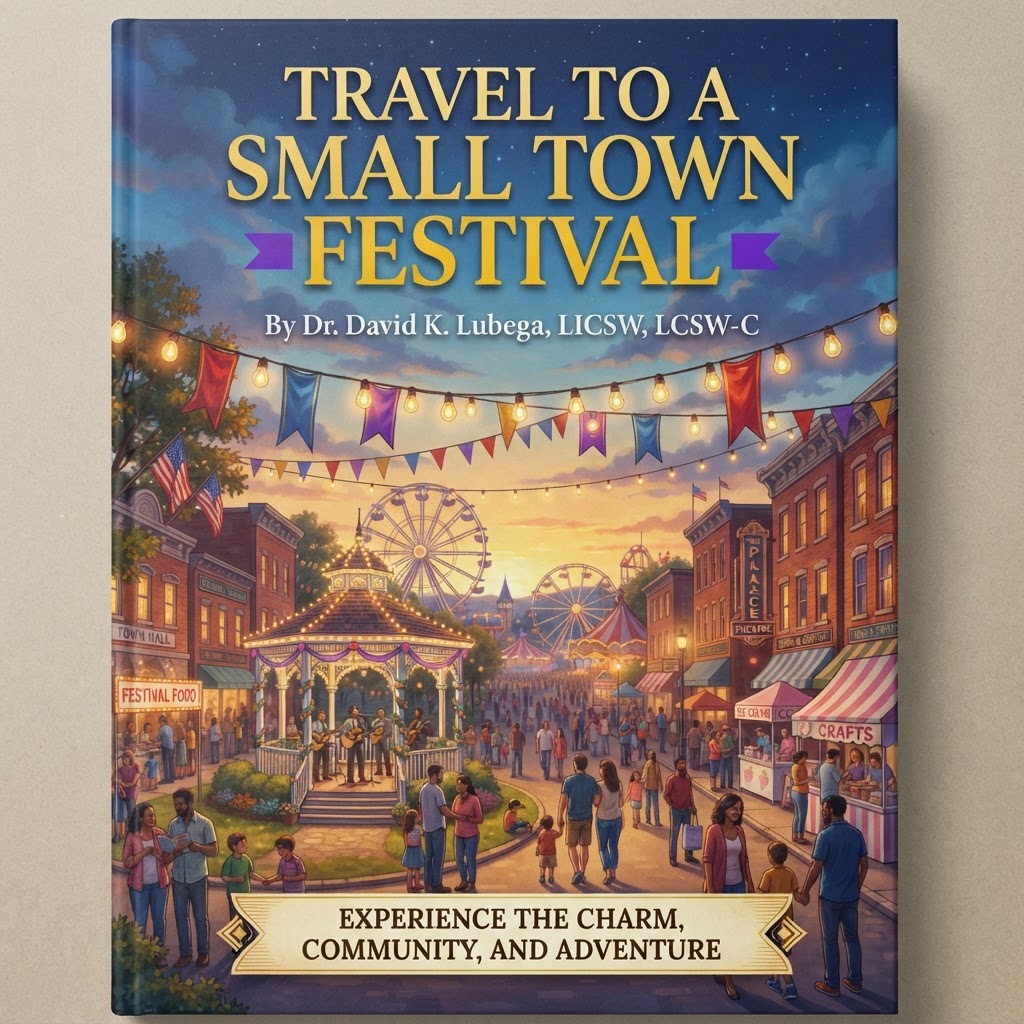
A Traveler's Guide to Real America
Travel To A Small Town Festival
Finding Belonging, Roots, and a Little Bit of Magic on America's Main Streets
Dr. David K. Lubega, LICSW, LCSW-C
Licensed Clinical Social Worker
Contents
Table of Contents
About This Guide
Part travel guide and part meditation on belonging, this book is for anyone who has felt the pull of the small town festival — the strawberry social, the founders' day parade, the harvest celebration — and wondered whether it is worth the drive. Dr. David K. Lubega, LICSW, LCSW-C shows you how to find the real festivals, how to plan a weekend around one without overplanning the joy out of it, how to be the kind of visitor a town is glad to see again, and what to do with the day once you are there. More than a guidebook, it is an argument that these festivals are one of the last widely accessible antidotes to the rootlessness of contemporary life — and that going, with the right attention, can change something in you that a bigger destination cannot reach.
Chapter 01
The Pull of the Small Town Festival: Why We Go
There is a particular kind of longing that surfaces in the middle of a busy, overstimulated life — a longing not for a faraway country, but for a place that feels like it belongs to someone. A place with a name you can say in one breath, a main street you can walk in ten minutes, and a festival where the whole town turns out because that is simply what the town does.
This is a book about that longing, and about where it leads: to the small town festivals that still happen, all across America, in every season and in every region, attended by people who have done it for decades and by travelers who have just discovered it exists. It is part travel guide and part meditation on why these places matter — and why, in a culture that has never been more connected or more lonely, traveling to one of them can change something in you that a bigger, shinier destination cannot reach.
The Yearning Beneath the Itinerary
Most travel writing is about arrival — about the landmark seen, the meal eaten, the photograph taken. This book starts somewhere earlier, with the feeling that makes you want to go in the first place. Because the truth is that very few people travel to a small town festival for the festival alone. They go because something in their ordinary life has gone thin.
We live in an era of frictionless everything: food delivered in minutes, entertainment on demand, a thousand people reachable in a single swipe. And yet study after study finds the same thing — Americans are lonelier, more anxious, and less rooted than they have been in generations. We have gained convenience and lost something harder to name. The sociologists call it belonging. The old-timers just called it knowing your neighbors.
A small town festival is one of the last places where that older kind of belonging is still practiced in public. When you walk onto the closed-off main street and the woman at the pie booth knows your grandmother's name, and the parade marshal is the same man who taught your father to drive, you are not attending an event. You are stepping into a living thing — a web of relationships and memory that did not begin when you arrived and will not end when you leave. You feel it the moment you arrive, in the way strangers nod at you. It is not performance. It is habit, and it is the rarest thing in modern America.
What a Festival Actually Is
To understand why this matters, it helps to know what a festival is, underneath the corn dogs and the funnel cakes. A festival is a community's annual act of remembering itself.
Every town that holds one is, in effect, saying: this is who we are, this is what we have done together for a long time, and this is what we will do again next year, with or without you. The strawberry festival is not really about strawberries. The Founders Day parade is not really about the founders. They are about the fact that, for one weekend, a town that is usually busy with its private life becomes, briefly, a single shared thing. The festival is the rare hour when the we is bigger than the I.
When you travel to one as a visitor, you are not crashing a private party. You are being invited into the oldest human ritual there is — the ritual of gathering, in a particular place, at a particular time, to mark that we are still here. The best festivals make visitors feel it immediately. They sell you a raffle ticket and tell you the prize, and for the rest of the afternoon you are, a little bit, one of them.
The Traveler's Privilege
There is something the travel industry rarely admits: the most meaningful trips are often not the most expensive or the most exotic. They are the ones that put you in contact with a place that has a real life of its own, one you did not design and cannot replicate. A small town festival offers this in a pure form. You are not the main character. The town is. And the relief of that — of being, for a weekend, a welcomed guest in someone else's story — is one of the most restorative feelings a traveler can have.
This book will show you how to find these festivals, how to plan a trip around one without overplanning the magic out of it, how to show up as the kind of visitor a town is glad to see again, and what to do once you are there so that you come home with more than photographs. But it begins with the why, because the why is what makes the whole thing worth the drive. And the why, for most of us, is simpler than we let on: we want to feel, for a little while, like we belong to a place.
A Note From the Author
I have spent my career as a clinician sitting with people who, in one way or another, are grieving the loss of exactly this — of roots, of ritual, of the feeling that they are part of something older and larger than themselves. I have come to believe that the small town festival is not a nostalgic curiosity. It is one of the last widely accessible antidotes we have to the rootlessness of contemporary life. You do not have to move to a small town to benefit from it. You only have to visit, with the right kind of attention, and let it work on you. That is what the rest of this guide is for.
— Dr. David K. Lubega, LICSW, LCSW-C
Chapter 02
Finding Your Festival: A Field Guide to the American Calendar
Before you can travel to a small town festival, you have to find one worth the trip. And here is the good news, the kind of news that changes the shape of your year: in America, on almost any weekend between April and October, within a day's drive of almost anywhere, a small town is throwing a festival. The challenge is not scarcity. It is knowing where to look, and learning to tell the genuine article from the dressed-up tourist trap.
This chapter is a practical field guide — how to find the festivals, how to read whether one is worth the journey, and how to build a personal calendar of small-town weekends that will quietly become the best part of your year.
Where the Real Festivals Hide
The festivals worth traveling for almost never advertise nationally. They do not need to. Their audience is the town and the surrounding county, and that audience already knows. To find them, you have to go where the towns themselves talk:
— *Local newspaper archives and event calendars.* The weekly paper of a small county is one of the great undiscovered resources of American travel. A paper that publishes four pages of church suppers and road work will reliably list the dates of the strawberry festival, the fall foliage parade, and the founder's day picnic — often months in advance, and with a specificity no travel site bothers with.
— *State tourism sites, read sideways.* The official state tourism site will push the big, sponsored events. But buried in the "small towns" or "off the beaten path" sections, almost every state maintains a calendar of community festivals. Read past the first page. The gold is in the second tier.
— *Regional Facebook groups and town pages.* Small towns run on Facebook in a way cities do not. A search for the name of a town plus "festival" or "celebration" will often surface a community page run by a volunteer with the full schedule, the parade route, and the pie-contest rules.
— *Word of mouth, deliberately cultivated.* Ask. Ask the person at the gas station in a town you are passing through. Ask your coworker where her parents still go every Labor Day. The best festivals I have ever attended I found because someone said, offhand, "Oh, if you're going to be in that part of the state that weekend, you have to see the –."
The Calendar, Season by Season
Once you start looking, a loose annual rhythm emerges. A useful way to think about it:
*Spring (April–June)* is the season of the crop festival — strawberry, asparagus, peach, lilac, rhubarb. These are small, sweet, day-trip events built around the first harvest. The towns are green and uncrowded, and the pace is gentle.
*Summer (July–August)* is the high season — county fairs, heritage days, Independence Day celebrations, founders' picnics, rodeos. These are bigger, longer, louder, and the most likely to have a parade, a midway, and fireworks. Plan early; the good inns fill by March.
*Early fall (September–October)* is, for many travelers, the best of all — the harvest festivals, apple butter stir-offs, pumpkin weigh-offs, fall foliage parades, and Oktoberfests in towns that have been doing them for a century. The weather is golden, the crowds are happy, and the food is the best of the year.
*Late fall and winter* is the season of the small, defiant festival — the Christmas stroll, the winter carnival, the ice festival, the chili cook-off. These reward the dedicated traveler with a kind of coziness you cannot manufacture in July.
How to Tell a Real Festival From a Tourist Event
Not every event calling itself a festival is what this book is about. A few questions will sort them:
— *Who is it for?* A real festival is, first, for the town. A tourist event is, first, for visitors. If the website leads with "Come experience our charming small town," be cautious. If it leads with the schedule of the parade, the pie contest, and the 5K — and treats visitors as welcome extras — you have found the real thing.
— *How long has it been going?* A festival that is on its 67th year is a different animal from one on its third. Longevity is not a guarantee of quality, but it is a strong signal of a thing the town has woven into its identity.
— *Who runs it?* Festivals run by a volunteer committee of locals, the fire department, the Lions Club, or the historical society are almost always the genuine article. Festivals run by an outside production company for a town are usually a product.
— *Is there a parade?* This sounds trivial, but it is one of the best filters I know. A town that closes its main street for a parade is a town that still treats the festival as a public, shared thing. A festival with no parade, only a vendor market, is more often a craft show with a festival name.
Building Your Own Calendar
The practical takeaway is this: start a list. Right now, this season. Write down every festival you hear about that sounds even a little interesting, with its town, its rough date, and the one sentence someone said about it. By next year you will have a personal calendar of possibilities, and the only problem left will be choosing. The chapters that follow assume you have chosen — that you have a date circled and a town in mind — and will help you make the most of it.
Chapter 03
Planning the Trip: How to Arrive Ready, Without Overplanning the Joy Out
A small town festival is a thing that rewards a particular kind of planning: enough that you actually get there and have a place to sleep, but loose enough that you can wander, change your mind, and let the day tell you what it wants to be. Most travelers err in one direction or the other — they either show up with no plan and spend the day frustrated by a sold-out inn and a closed road, or they schedule every hour and arrive so committed to their itinerary that they miss the thing the festival actually is.
This chapter is about the middle way: the small, specific kinds of planning that make a festival weekend effortless, and the equally specific kinds of planning to leave undone.
Book the Bed Early; Everything Else Late
The single most important piece of festival planning is also the most boring: where you will sleep. Small towns have very little accommodation, and the good rooms go months ahead. A town with two inns, one bed-and-breakfast, and a motel on the edge of town will be fully booked by May for a July festival. If you wait, you will end up forty minutes outside of town, which changes the entire experience — you become a commuter rather than a participant, and you miss the quiet early morning and the late-night walk back that are two of the best parts of the trip.
So: the moment you pick a festival, book the closest room you can afford, even if it is a year out. This is the one piece of planning worth doing aggressively.
Everything else — the meals, the activities, the exact hour you arrive — leave open. A festival weekend is not a vacation itinerary; it is a shape you step into. The town has already built the schedule. Your job is to be present for it, not to impose your own on top of it.
Arrive the Day Before, If You Possibly Can
One of the most reliable pieces of advice in this book: arrive the evening before the festival begins, not the morning of.
The day before is when you meet the real town. The volunteers are stringing lights and setting up booths, the bakery is making three times its normal bread order, and everyone is in a particular good mood that comes only from anticipation. Walk the main street. Buy a coffee. Ask someone what is good. You will learn more about the festival in an hour of the day before than in a full day of the festival itself, because the day before, people have time to talk.
It also lets you sleep in the town, wake up in it, and walk to the festival rather than driving in and hunting for parking with a thousand other people. The difference between driving to a festival and walking to one is the difference between attending a thing and being part of one.
Pack for the Day, Not for the Photo
Small town festivals are mostly outdoors, mostly unhurried, and mostly weather-dependent in a way city events are not. A few packing principles that will save you:
— *Layers, always.* A festival morning can be 55 degrees and its afternoon 85. The people enjoying themselves are the ones who can peel off and pile on. A light jacket you can tie around your waist is worth more than three nice outfits.
— *Comfortable shoes you do not mind getting dusty.* You will stand, walk, and possibly stand in grass or gravel for hours. This is not the weekend for new shoes.
— *Cash, in small bills.* Many festival booths still do not take cards, and the pie lady does not want to make change for a fifty. A pocket of ones and fives marks you instantly as someone who has done this before.
— *A folding chair or blanket, if the festival has a parade or an outdoor concert.* The people who brought one are sitting comfortably an hour before the people who did not.
— *Less than you think.* You will walk. Everything you carry, you carry. A small bag with the essentials beats a backpack full of contingencies.
The Art of the Loose Plan
Once you are there, the best plan looks roughly like this: identify the two or three anchor events of the day — the parade, the pie contest, the evening concert — and commit to being at those. Then leave the hours between them open. Wander. Follow a sound. Sit on a bench and watch. Eat when the line at the food booth is short, not when you planned to. Talk to the person next to you.
A festival weekend is not optimized by planning; it is optimized by availability — by being available to whatever is actually happening, which is almost never exactly what was advertised. The travelers who have the best time are the ones who treat the schedule as a suggestion and the town as the main event. Plan the bed and the arrival. Then let the festival happen to you.
Chapter 04
How to Be a Visitor a Town is Glad to See
There is a kind of traveler a small town remembers, and a kind it endures. The difference is not money, or manners in the stiff sense, or how well you photograph the parade. The difference is something quieter and more interesting: it is whether you arrived as a consumer of the town or as a guest in it.
A consumer comes to take — a meal, a picture, an experience to post. A guest comes to receive — and, in receiving, to give the only thing a visitor can really give, which is genuine attention. Small towns can tell the difference within five minutes. And the experience you have — the warmth, the stories, the invitations to come back next year — follows almost entirely from which one you are.
This chapter is about the small, specific ways to be the kind of visitor a town is glad to see again. None of them cost anything. All of them will change your trip.
The First Hour Sets the Tone
How you spend your first hour in a festival town matters more than you would guess. The town is watching you arrive the way you are watching it — not consciously, but in that low-level way people register each other. The traveler who blows into town, parks badly, and asks the first person he sees where the festival "really" is has already told the town what he is. The traveler who slows down, buys something small, and asks a real question has told it something else.
A few practices for the first hour:
— *Stop before you rush in.* Park, then walk a block before you do anything else. Let the town become a place to you before it becomes an event. You will notice things — the handmade banner, the closed-up storefront with a hopeful new sign, the church with the festival parking — that the rushing visitor never sees.
— *Make a small purchase immediately.* A coffee, a bottle of water, a raffle ticket. You are no longer a person passing through; you are a person who has transacted with the town. The tiny ritual of exchange changes how you feel and how you are perceived.
— *Ask a real question.* Not "where is the festival" but "is this your first year running the booth?" or "what's the best thing on the schedule today?" A real question is an offering of interest, and in a small town, interest is currency. People light up when asked about the thing they care about.
The Conversations That Are Waiting to Happen
The great, under-discussed gift of a small town festival is that strangers will talk to you. In a city, talking to the person next to you at an event is a risk. At a small town festival, it is the default. The woman ahead of you in the pie line wants to tell you which one to buy. The man on the bench wants to tell you about the year the parade got rained out. The volunteer at the historical society table wants to tell you how the town got its name.
The only thing required of you is to be available for it. Put the phone away. Stand still. Make eye contact. Say hello first. Ask the follow-up question. You will be astonished, every time, by how much people will tell a stranger who is simply listening.
A practical habit: aim for one real conversation at every festival you attend, with someone who lives there. Not a transaction, not a passing remark — a conversation. Ask where they are from, how long they have been coming to the festival, what they wish more visitors knew. These conversations are the souvenir that does not fit in a bag, and they are the ones you will remember in twenty years.
The Small Courtesies That Mark You
Small towns register courtesy the way cities do not, because the scale makes every interaction visible. A few courtesies that will mark you, to the town, as someone who knows how to visit:
— *Park where you are welcome, not where it is closest.* A town that has opened its main street to you has also, quietly, opened its side streets. Do not block a driveway. Do not take the spot the shop owner needs. Walk a little farther than you have to. It is noticed.
— *Buy something from a kid.* The 4-H booth, the Scouts' table, the school club's fundraiser. The transaction is small to you and large to them, and the town sees you do it.
— *Stay for the whole thing.* A surprising number of visitors leave right after the headline event. Staying for the wind-down — the last song, the booth teardown, the volunteers sitting in folding chairs in the empty street — is when the town is most itself, and it is when you stop being an audience and become, briefly, one of them.
— *Say thank you, specifically.* Not a generic thanks to the air. "Thank you for running this — we drove three hours and it was worth it." Say it to a volunteer, by name if they are wearing a nametag. They will remember you. They will tell the others. You will be welcomed back as someone the town knows.
What You Are Really Giving
The deepest thing you give a small town by visiting its festival well is not your money, though that matters. It is the proof that the thing they have built matters beyond their county line — that a stranger drove a long way because they heard about it and wanted to see. Every small town that keeps a festival alive for decades is, in part, fighting the quiet fear that no one outside cares. Your presence, offered well, tells them someone does. That is a gift you cannot overestimate, and it is the reason the best visitors are remembered long after the festival is packed up.
Chapter 05
The Day of the Festival: A Walking Guide to Getting the Most Out of It
The morning of the festival is its own kind of magic. The town has been preparing for a year, and by the time you step onto the street, it has become, for one day, the most fully alive version of itself. This chapter is a walking guide to that day — where to go, what to do, in what order, and how to let the hours carry you rather than driving them.
Think of it less as an itinerary and more as a shape — a way of moving through the day that puts you in the path of the best of what the festival has to offer.
Early Morning: The Town Waking Up
If you have taken the advice of the last chapter and arrived the night before, you have a gift most visitors do not: the morning before the crowds. Use it.
Walk the main street before the booths are fully open. The bakers are at work. The volunteers are hanging last-minute banners. The air smells like coffee and grilled onions. This is the festival at its least polished and most real, and the people you see are the ones who make the whole thing happen. Smile. Say good morning. You are seeing the town in its work clothes, and it is the best version of it.
Find the breakfast. Almost every festival town has one — a church pancake feed, a firehouse breakfast, a Lions Club eggs-and-bacon. Go. The food is cheap, the coffee is strong, and you will sit at a long table next to people who have been eating this breakfast on this morning for thirty years. Listen more than you talk.
Mid-Morning: The Parade
If the festival has a parade, and most do, this is its center of gravity. The parade is not just a spectacle; it is the town's annual roll call — the fire trucks, the high school band, the 4-H club, the elected officials in convertibles, the homemade float that a family spent two weeks on. To watch it is to meet the whole town in twenty minutes.
A few notes for doing it well:
— *Claim your spot early.* The good curbside spots go an hour before the parade starts. Bring your folding chair or blanket and settle in. The waiting is part of the event — it is when neighbors catch up around you, and you will overhear the real history of the town.
— *Stand for the veterans.* Every small town parade has a color guard or a veterans' contingent. When they pass, the crowd stands and the men remove their hats. It is one of the last genuine public rituals in American life, and participating in it — standing, quietly, with the people who live there — is one of the things that makes the day matter.
— *Cheer for everything.* The kids on the soccer float, the Shriners in their tiny cars, the antique tractor that barely runs. A parade audience that cheers is a parade audience that belongs. You will feel the difference.
Midday: The Festival Floor
After the parade, the festival fully opens. This is the part most travelers over-manage and most locals under-manage, because locals know the secret: you do not have to see it all. The festival is not a museum with a checklist; it is a street party. Walk it. Stop where something catches you. Let the day tell you where to go.
A few reliable anchors:
— *The food booths.* Seek out the ones run by local organizations rather than traveling vendors. The church selling pulled pork, the ethnic heritage society selling pierogi, the Cattlemen's Association grilling ribeyes. This is where the town feeds itself, and it is the best food of the day. Eat standing up, at a folding table, next to someone you do not know.
— *The contests.* The pie judging, the baby contest, the pie-eating contest, the livestock show. These are the events the town cares most about and visitors attend least. Go. The pride on a 4-H kid's face as she shows the lamb she raised is worth more than any concert.
— *The historical society booth.* Almost every festival has one. It will have old photographs, a local historian, and the long story of how the town came to be. Spend fifteen minutes here. It will change how you see the rest of the day.
Afternoon: The Slow Hours
The early afternoon, after the parade crowds thin and before the evening events, is when the festival breathes. This is the hour to find a bench, to sit in the shade, to eat the pie you bought, to let the day settle. Resist the urge to fill it. The slow hours are when you actually feel the place — the particular quality of its light, the sound of its band tuning up, the way its people move around each other. This is the part of the festival you cannot photograph or narrate. It is the part you absorb.
Evening: The Town as Stage
As the light goes, the festival becomes a different thing. The string lights come on. The band takes the gazebo stage. The crowd shifts from families to everyone. This is the hour the town has been building toward all day.
Find the music. Whether it is a country band, a polka orchestra, a community choir, or a single guitarist on a bench, the evening music is the heart of the festival. Dance if there is dancing, even badly. Stay until the last song. The walk back to your room, through the quieting town, is the best ending a day can have, and it is the moment, more than any other, that you will remember in the years to come.
Chapter 06
Coming Home Changed: What a Small Town Festival Gives You to Keep
The drive home from a small town festival is a particular kind of quiet. The radio is off, or low. The window is down. The fields are gold in the late light, and the town you just left is shrinking in the mirror, getting back to its ordinary life, which it will live without you for another year.
This final chapter is about what you carry out of that quiet — what a weekend at a small town festival, done well, actually gives you to keep. Because it is more than you think, and it is not what the travel industry measures.
The Photographs Are the Least of It
You will take photographs, and you should. But the photographs are not the souvenir. A picture of a parade is a picture of a parade; it could be anyone's. What you actually brought home is not visible.
You brought home the way the air smelled at six in the morning, before the booths opened. The exact taste of the pie the woman at the church booth pressed on you because you had never tried it. The name of the old man who told you, for an hour, how the town got its start. The feeling of standing for the color guard while the whole street went quiet. The particular gold of the light when the band played the last song.
None of that fits in a camera. It fits in you. And it is the real harvest of the trip.
A Restored Sense of Scale
One of the quiet gifts of a small town festival is a corrected sense of scale. We spend most of our lives in systems built for speed and size — the highway, the airport, the algorithm, the inbox. These systems train us to think that bigger is better, faster is smarter, and that a place is only worth attending to if it is the biggest version of itself.
A small town festival undoes this training for a weekend. It shows you that a thing can be small and still matter enormously. That a parade of thirty units can be more moving than one of three hundred. That a band of local volunteers can make you feel more than a stadium act. That a town of two thousand people can have a deeper sense of itself than a city of two million. The scale you are restored to is the human one, and you come back to your regular life with a quiet, recalibrated sense of what is actually enough.
The Belonging You Did Not Know You Were Missing
If there is one thing I have learned, as a clinician, about the loneliness of contemporary life, it is that most people are not lonely because they lack company. They are lonely because they lack belonging — the feeling of being part of a place and a people who would notice if they were gone.
A small town festival will not move you there. But for a weekend, it lets you borrow the feeling. And borrowing it is not a small thing. It reminds the body what belonging feels like, and once the body remembers, it begins, quietly, to look for it at home. People who travel to small town festivals regularly almost always report the same downstream effect: they come home and start knowing their neighbors. They start a small ritual. They build, in their own life, a smaller version of the thing they visited. The festival does not just give you a weekend. It gives you a model for how to live.
A Deeper Kind of Travel
The kind of travel this book is about is an older kind than the one most of us were raised on. It does not optimize. It does not collect. It does not rank. It asks something simpler and harder: will you go somewhere real, be present for it, and let it change you a little?
A small town festival rewards this kind of travel more than almost any other destination, because it is, by its nature, real. It is not built for you. It is the town's own life, shared with you for a weekend. When you meet it with that kind of attention, you are not a tourist. You are a traveler in the oldest sense — a person who goes to meet the world as it is, and comes home a little wider for having met it.
A Word to the Reader Who is Still Hesitating
If you have read this far, you are someone who feels the pull I described in the first chapter — the longing for a place that belongs to someone, for a weekend of belonging you can borrow. Maybe you have been telling yourself you are not the festival type, or that it is too far, or that you will go next year.
Go this year. Pick one. Any one. Drive there the night before. Walk the empty main street in the morning. Eat the church breakfast. Stand for the color guard. Stay for the last song.
I will make you a promise, the same one I make to anyone who has ever sat in my office wondering whether their life is supposed to feel this disconnected: the small town festival is still there, still doing what it does, still glad to see you. It has been waiting longer than you have. It will wait one more year, but you should not. The world that holds these festivals is itself a fragile thing, and the towns that keep them alive do so on the faith that someone still cares. Be the someone.
Go. Be the kind of visitor a town is glad to see. Come home changed. And then, when you can, go again — to the same town, if you found one that took you in, or to a new one, because there is always another one, somewhere, on the calendar, closing its main street next Saturday for the 68th year, and wondering who might come.
— Dr. David K. Lubega, LICSW, LCSW-C
Dr. David K. Lubega, LICSW, LCSW-C
Licensed Clinical Social Worker
Dr. Lubega has spent over 15 years in clinical practice walking alongside people who, in one way or another, are searching for belonging. A lifelong traveler of America's small towns, he has come to believe that the community festival is not a nostalgic curiosity but one of the last widely accessible antidotes to the rootlessness of contemporary life — and that the willingness to drive a long way to attend one is, quietly, an act of hope.
DigitalShelf

